Installation View / Gallery La Nube di Oort,
Rome
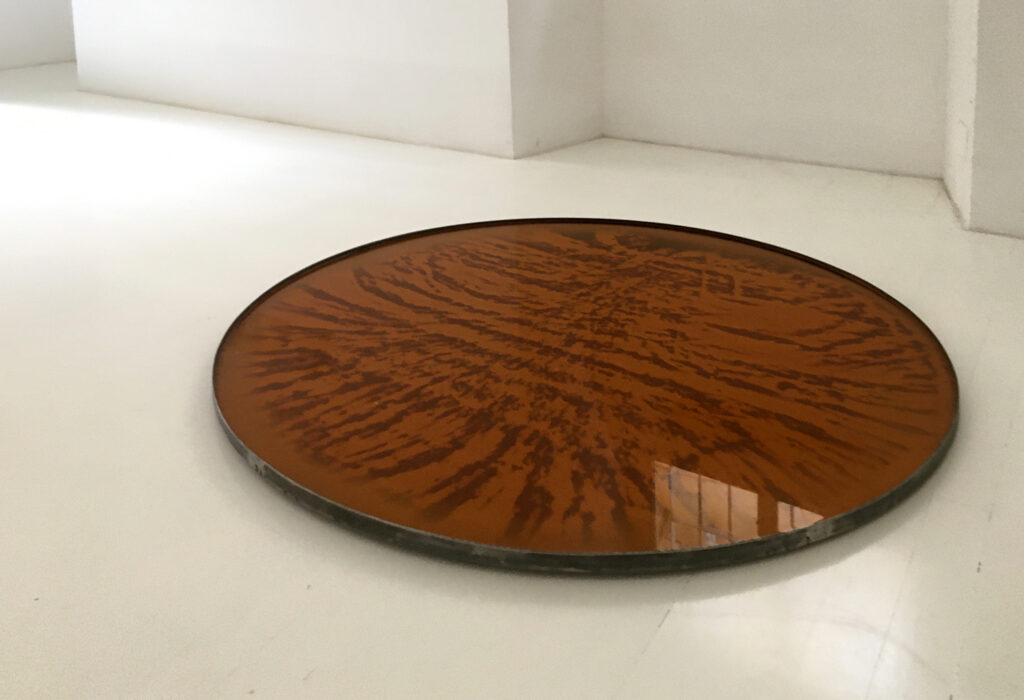
The Emperor’s Mirror
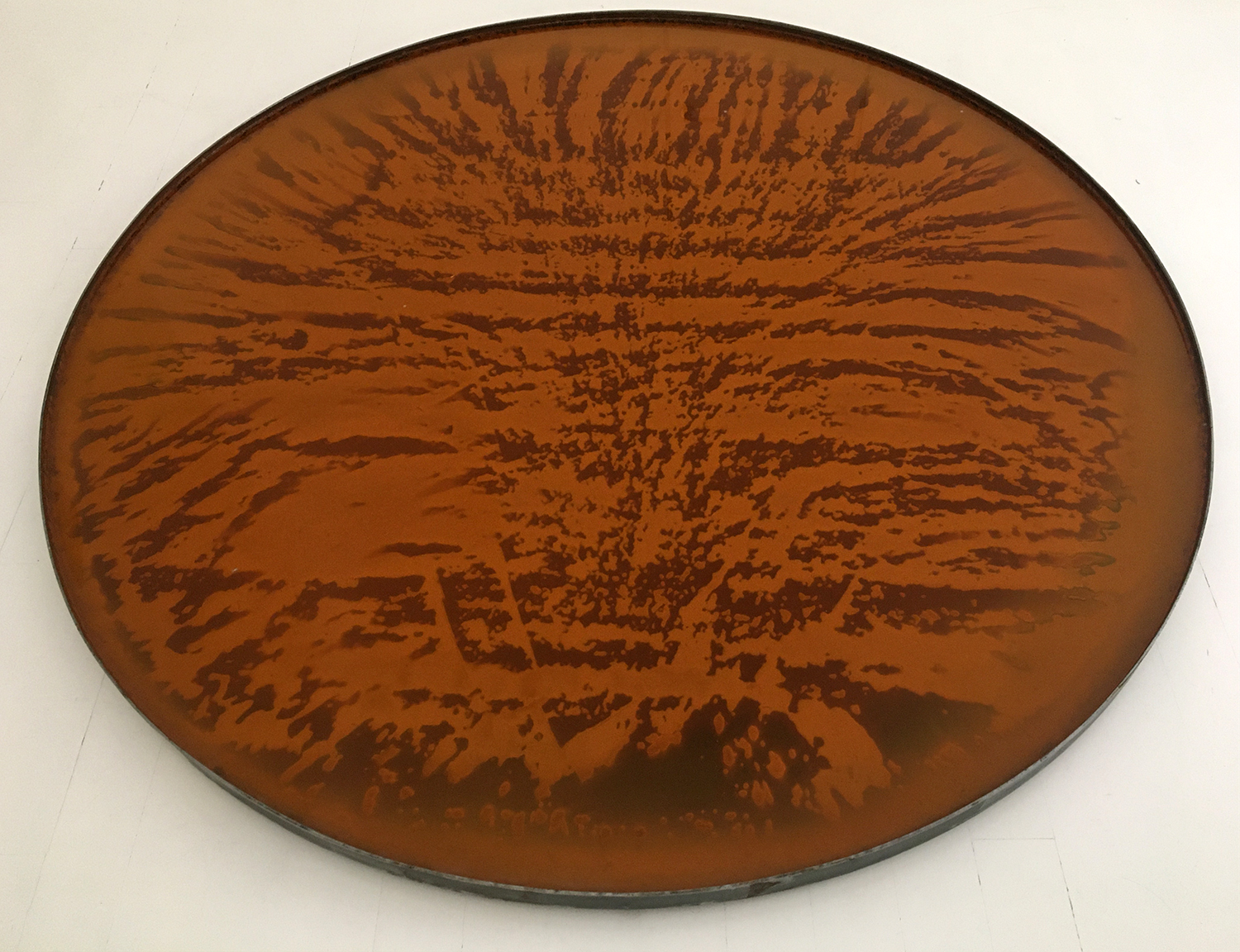
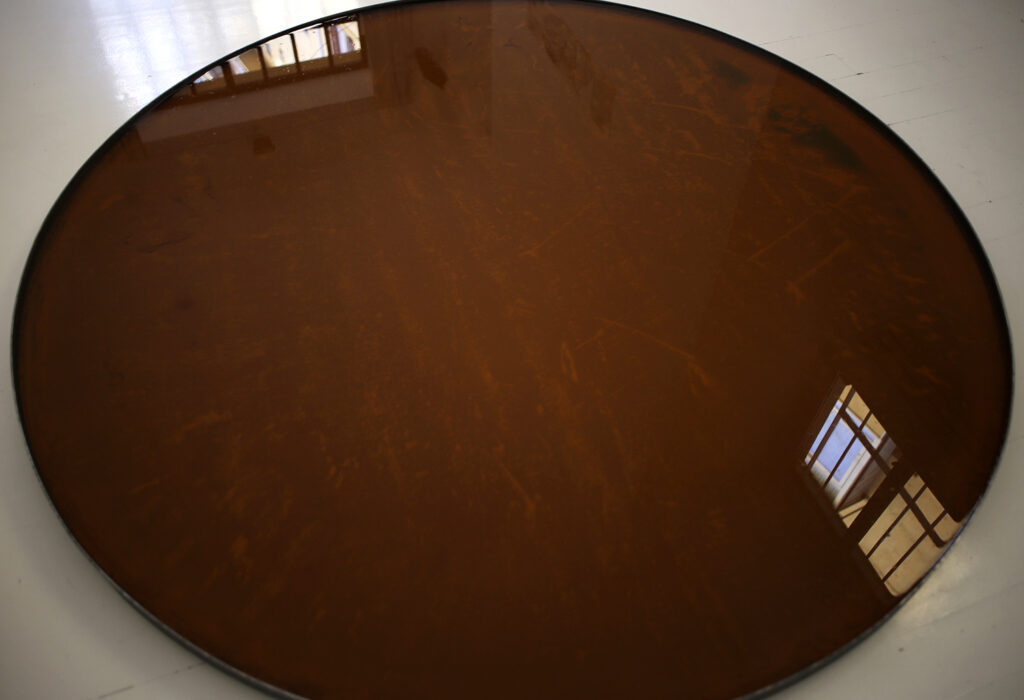
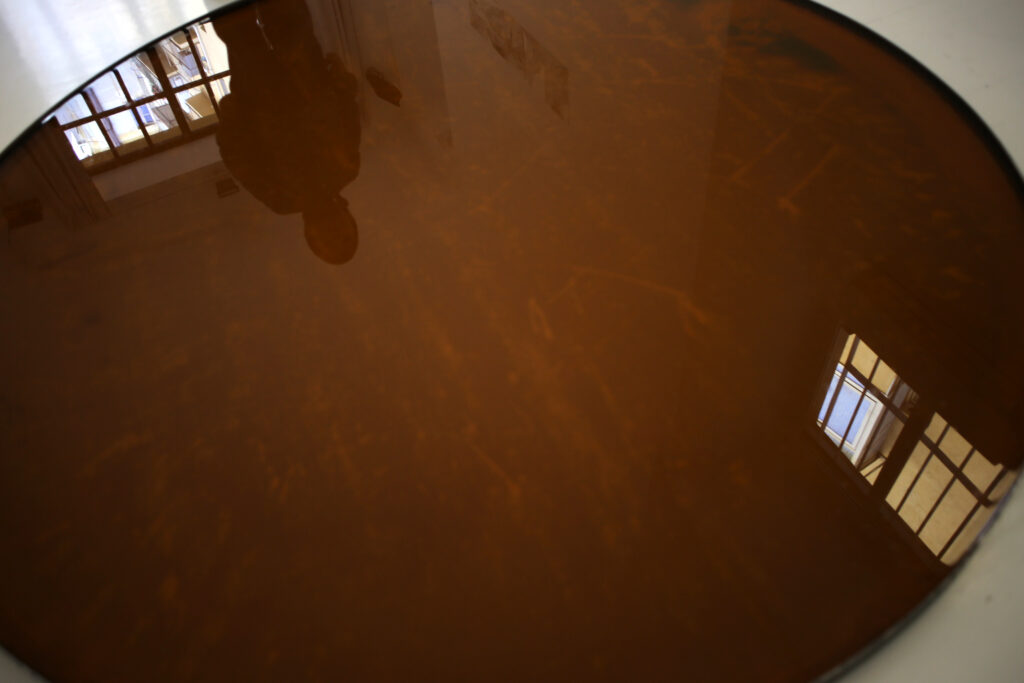
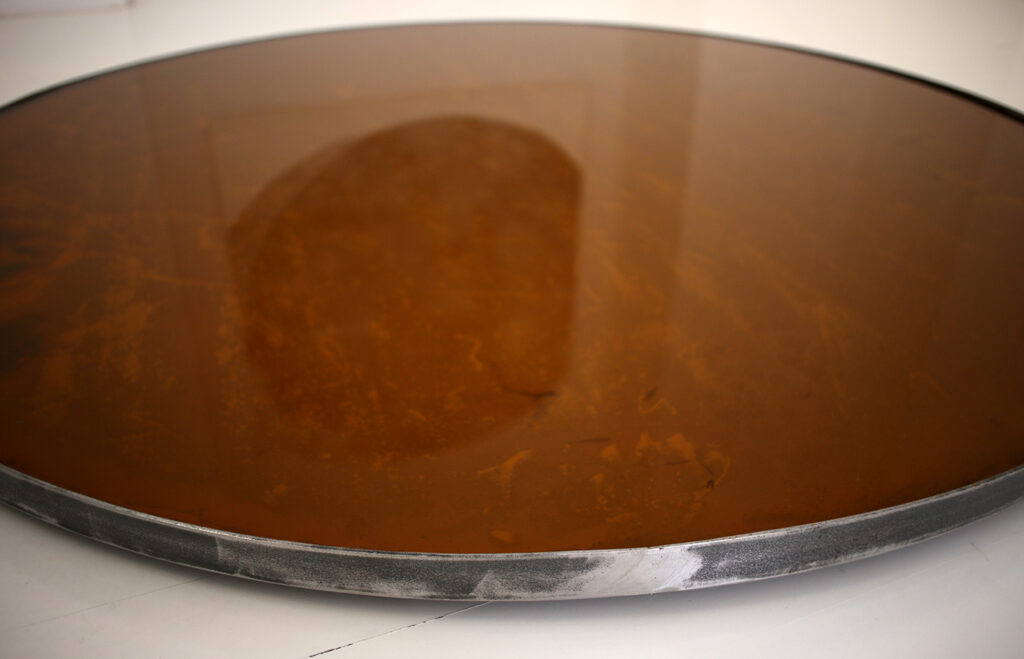
Diana Legel belongs to the artists who choose essentiality and abstraction to express complexity. She uses drawing made up of rapid, impatient strokes, sometimes made with both hands in a hymn to symmetry. Drawings, she says, that come into being progressively, the hatching extends gradually and the strokes condense like an organic growth. They are images that capture, that convey all their enigmatic power. But the exhibition of drawings at La Nube d’Oort, with the ground installation of a circular sculpture in steel and water, a mirror, goes a step further. It opens the way to a broader vision, consonant with her level of full artistic maturity.
Diana Legel’s abstract art requires the visitor to pay more attention and concentration, while at the same time leaving them greater freedom of interpretation and elaboration. Beginning with the dialogue between the circular mirror of the floor sculpture and the drawings of the series ‚Vitruvianische Kreise‘ (Vitruvian Circle), all of which, including the sculpture, are linked to the physical dimension of the artist herself. A declaration of wanting to remain anchored to the ‚measure of man‘, with all that this entails. The presence of the mirror, in a sequence of meanings, speaks of self-consciousness/self-perception. It brings to mind the principles of symmetry: symmetry in the mirror as invariance in relation to a transformation, and its breaking, fundamental phenomena in the creation of the universe. It makes one think of Alice’s mirror in Lewis Carroll’s „Through the looking glass and what Alice found there“ by Lewis Carroll, of what happens when one crosses it and one embarks on a journey into the unconscious. And why not, to the mirror of a Japanese emperor of the Heian era who only looked at the moon through a mirror. In a game of typically oriental symbolic references, in which the kagami mirror reflects the contents of the heart and conscience, the revealer of truth and from which nothing can be concealed. In a world, according to the Shintoist belief, in which everything is a mirror of everything else.
The exhibition is enhanced by a series of five drawings and a series of other small drawings arranged in columns, reminiscent of the pages of a diary, telling of how the perfection of the sign can be achieved.
Completing the exhibition are two drawings executed four-handed with artist Iulia GhiXa, tangible proof of similar sensitivities and the originality that emerges from similar, infrequent, collaborations.
Cristian Stanescu, La Nube di Oort, Rome, March 2024