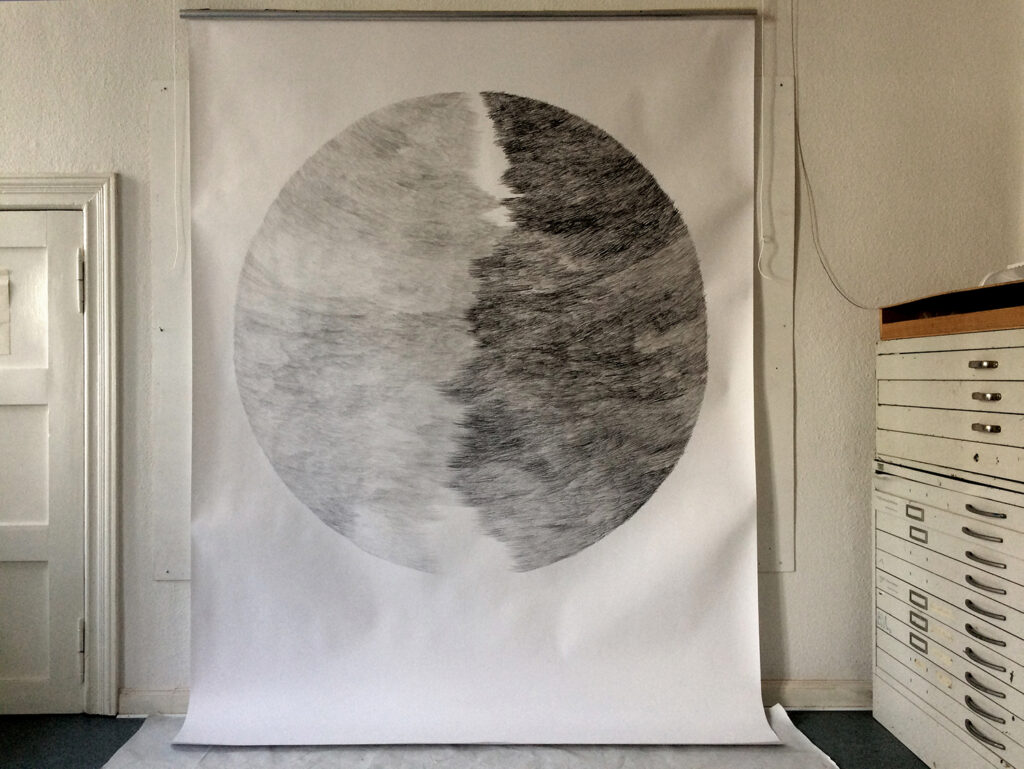
Installation View
Diana Legel: With Both Hands
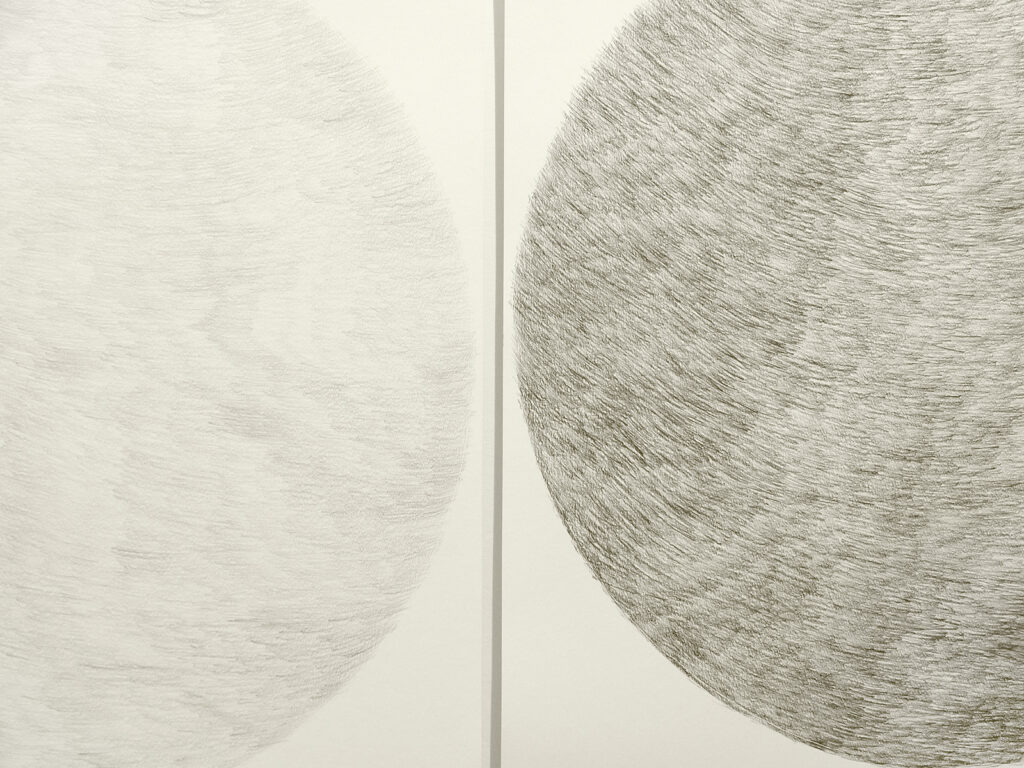
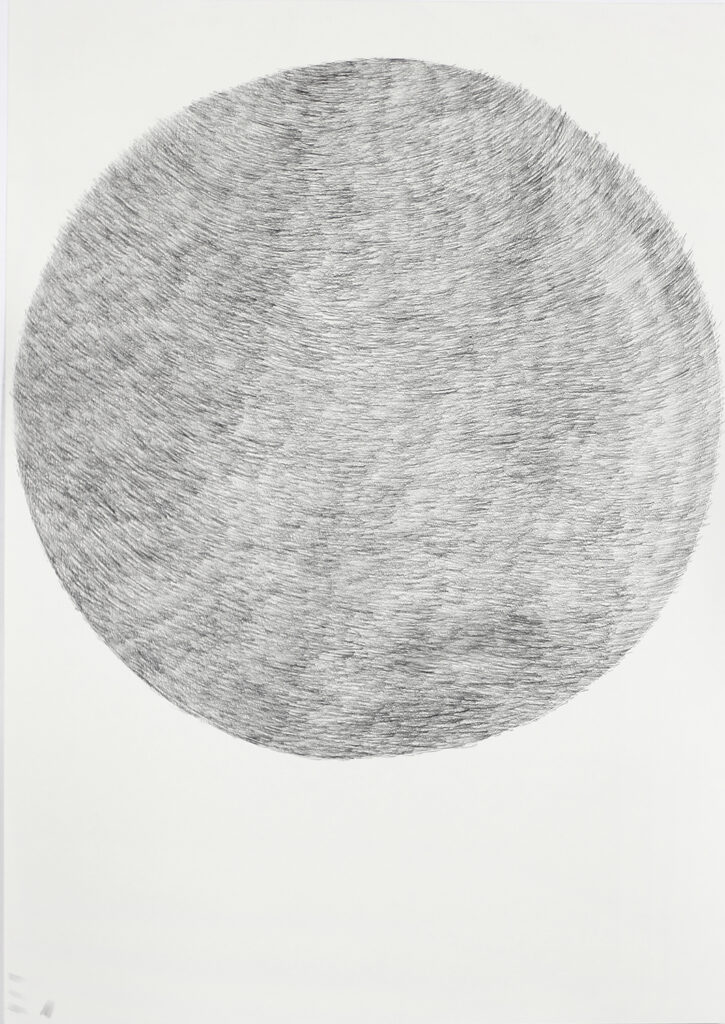
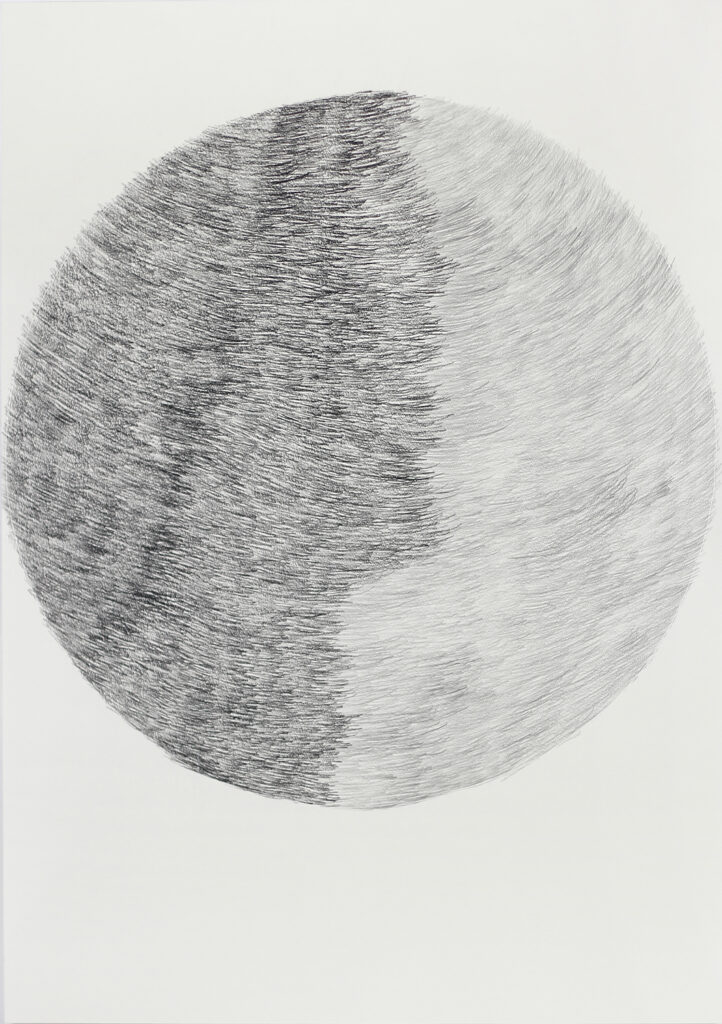
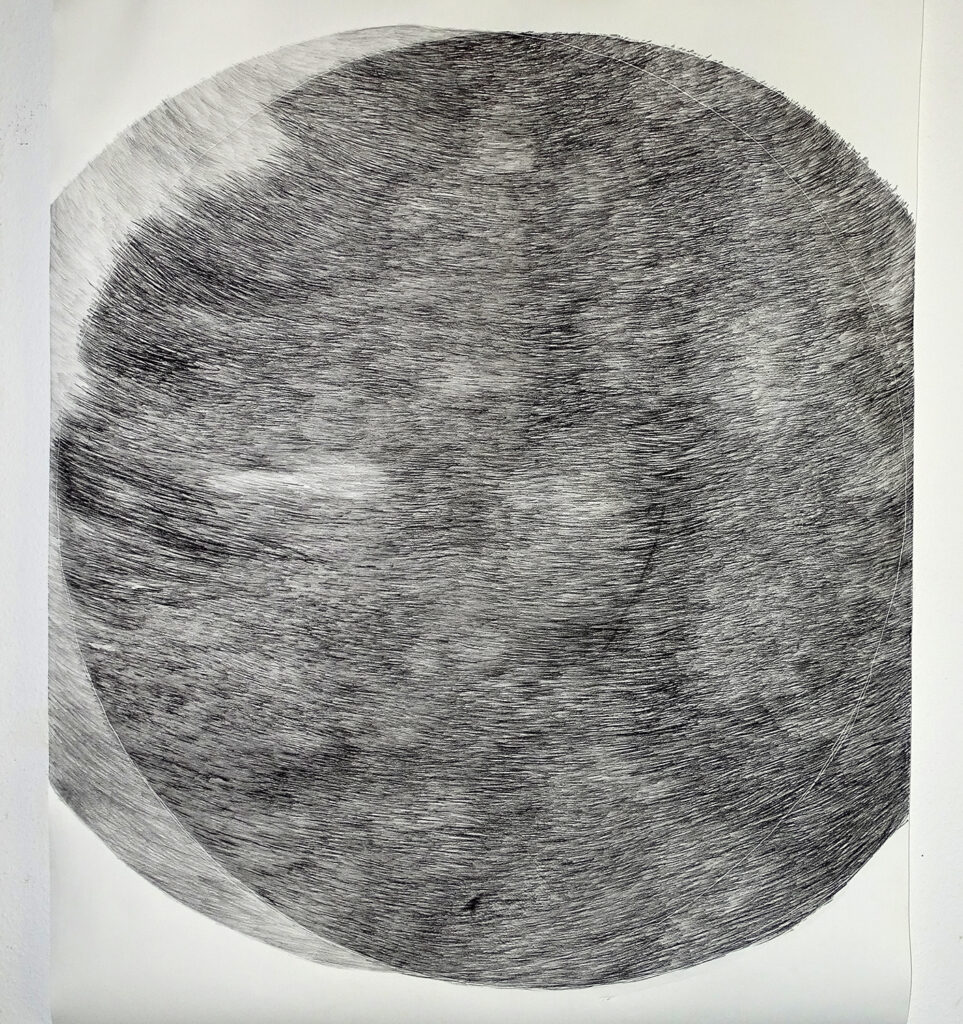
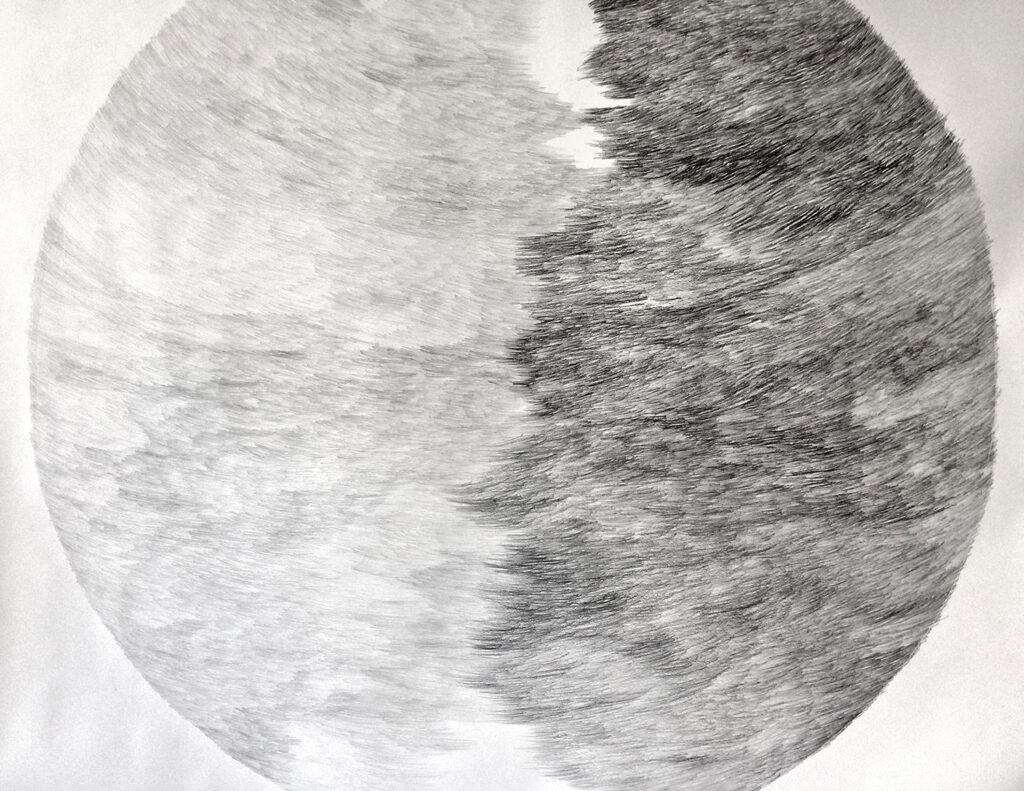
Diana Legel draws. She draws with two hands, the educated, conditioned right hand and the less precise, less calculating left hand. Her drawings thrive on the contrast created by this technique, by different textures and fabrics, but also by the use of different materials – charcoal or pencil, which make the difference more obvious. She started out as a sculptor, and tracing the lines on paper is reminiscent of the rhythm of the chisel’s work as it carves stroke after stroke into stone. However, her drawings that appear to be abstract often start from concrete references – for example the shadow of the nuts or in the case of the works exhibited here, herself, her body.
The diameter of the circle, or rather of each of the two overlapping circles in Vitruvianischer Kreis I, corresponds to its height of 163.5 centimetres. Fundamental concepts of representation intersect here: the circle is a simple yet infinitely complex form, and is one of the universal symbols found in nearly every culture and historical era. As an autonomous line without beginning or end, it represents completeness and unity. In many cultures, the circle symbolises the idea of perfection. It is a symbol of integration in which all opposite or complementary aspects of life can coexist in harmony. In psychology, it is a symbol of the psyche representing a totality of being, the union of consciousness and the unconscious. At the same time it also symbolises the cyclical nature of life, the eternal return, in which every end is also a beginning.
This universal meaning also makes the circle a theme in art theory. In the anecdote of the ‚O di Giotto‘, recounted by Vasari in his ‚Vite‘ (Lives), the artist drew a circle without a compass for Boniface VIII as proof of his skills, and his talent is manifested precisely in his ability to draw a perfect circle.
A circle related to the human body certainly also brings to mind the Vitruvian man popularised by Leonardo da Vinci’s famous drawing of 1490, which is based on concepts from ancient philosophy: the union of art and science, through the circle and the square, symbolises the perfect nature of creation. The circle represents the cosmos, the square the earthly world, and man the union of microcosm and macrocosm, hence the very idea of the world. The Vitruvian man became a symbol of Renaissance art, man – understood as a male being – as the ‚measure of all things‘. And Vitruvian man does not indicate a specific measure that refers to the balance of proportions.
The human body in turn has since antiquity been the reference system for measuring the natural world and artefacts: the palm, the foot, the arm were until the introduction of the metre in 1793 with the French Illuminism the units by which everything was measured. And the measurement of one body in particular had a spiritual significance in the Christian world: the mensura Christi or longitudo Christi, found for example in manuscripts as a hand-drawn bar or line as wide as the width of the page allowed. These lines could be measured by the faithful and multiplied so as to draw the Son of God in all his height. The measurement had a theological significance, it was a mean of understanding the enigma of Christ’s Ascension by capturing a trace of his physical presence, and an apotropaic function: it could be kept with one as a good luck charm – perhaps rolled up in a piece of jewellery – or hung in the home to ward off bad luck.
Diana Legel’s drawing, which takes its starting point from the artist’s height measurement, is obviously not based on this theological concept but fits into a tradition that sees the measurement as a representation of the being itself: the measurement becomes an alter ego and, in a certain sense, a portrait. The circular water basin placed on the floor, which is always based on the same measure and in addition hides in the height of its rim a reference to the years of the artist’s life, reinforces this effect of self-portrait. It is hard not to think of Narcissus, a figure from Roman mythology, who falls in love in his reflection in the spring. While today this figure, which gives its name to narcissism, has a negative meaning in that it denotes a psychological attitude of excessive self-admiration and is synonymous with egocentrism and conceit, in art theory it has an entirely different meaning: In his treatise Della Pittura (On Painting), Leon Battista Alberti writes in the second book of 1436: „Therefore I used to say among my friends, according to the judgment of the poets, that Narcissus, converted into a flower, was the inventor of painting; for where painting is the flower of all art, there the whole story of Narcissus comes into play. What would you say is painting other than artfully abrading that surface of the fountain there?“. With this observation, reflecting on the portrait and the power of painting, Alberti presents a new theory of art, painting becomes a place of encounter with oneself.
Paper and pencil often represent the beginning of artistic creation processes: in the Renaissance, the idea of drawing as the father of all arts was established. Drawing is at the centre of Diana Legel’s artistic work as a form of immediate expression. Her almost meditative working process becomes visible in the repetitions and hatches, which can combine to form larger ensembles, in some works even associated with sculptural expressions. However, his drawing with both hands is not to be seen as a strategy to bring the left hand to the professional level of the right, but rather to establish an inner balance between the rational and irrational self, between the conscious and unconscious, which touches the core of artistic creativity.
Philine Helas